Author: The Messenger Voice

  • THE VIOLENCE IN BARKIN LADI

    THE VIOLENCE IN BARKIN LADI

    By V. AL-PEA

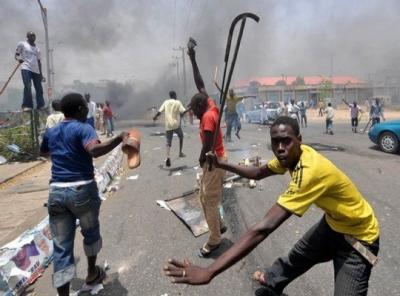
     The violence in Barkin Ladi, which peaked on Thursday, November 24th, 2011, had its roots on Sunday the 19th. Apparently, three young men were shot dead by Hausa youths as they rode their motorbikes, prompting reaction from the natives, which resulted in the deaths of some Hausa residents the next morning.

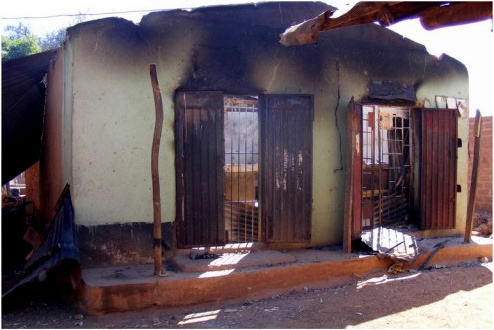
    According to an eyewitness, Enginner Toma Dung, whose nephew was killed, they woke up to the sound of “gunshots followed by religious chants– Allahu akbar, Allahu akbar!” at about 11:00 p.m. Wednesday night. Dung quickly gathered his family members and while they attempted to escape to safety his elder brother’s son, Pam Emmanuel Dung was shot and killed by the assailants. They then set his car and house ablaze, burning it to the ground.  The violence, which peaked on Thursday, is a product of revenge attacks.

    Confirming the incident, the Plateau State Commissioner for Information and Communication, Yiljap Abraham said the attacks were unfortunate. Accompanied by Pam Ayuba, Special Adviser to the governor on Media and Publicity, Abraham disclosed that about 60 people have been arrested and are being interrogated by security agents in connection with the disturbance. He further stated that the situation had been brought under control, as a 24-hour curfew has been imposed on the town. Abraham also said that the cause of the disturbance will be investigated even as security is fully in place to forestall future breakdown of law and order.

    An undisclosed number of innocent people lost their lives and property. Many residents who have been displaced have taken refuge in the Divisional Police Headquarters. Some of the internally displaced victims who spoke to TMV lamented the violence since the state had been experiencing some relative peace prior to these attacks.

    The flow of traffic on the road to Barkin Ladi has become cumbersome since security agents stop and search vehicles traveling in that direction.

    We are looking to write a follow up report on this recent violence.

  • JANG’S YOUTH PROGRAM Pt. 2

    JANG’S YOUTH PROGRAM Pt. 2

    By V. AL-PEA

    The following is the second half of interview with Special Adviser to the executive governor of Plateau State on Youth Development, Kwamkur Samuel Vondip. Click here to read the first half of the interview.

    TMV: Rumors making the rounds are about government’s selective approach towards youth development, especially along tribal line. How can you react to that?

    VONDIP: (Chuckles) you know rumours in Plateau State have become like cankerworm. (laughs) People spread rumours all over the place everyday. You will wake up and hear one rumour or the other. The governor was saying the other day, they say he is sick and I just said I went to the airport to see the man off and when I came back because of the high degree of rumour I was tempted to believe that the man collapsed while he was abroad, but in Plateau State, we really need to look back and work on what is concrete. The five-kilometer roads cover all the seventeen local governments of the state. Road constructions cover all the state. He has even called all the chairmen and warned them on the need to develop everybody. Check the appointments it was fairly shared, in fact some tribes have so many appointments that even some other tribes are complaining. Like in Tarok axis now we have two Commissioners in one local government. I mean, what do you have to show that it’s Berom agenda? So people are just saying those things to incite people that are ignorant. I have always challenged people to confirm just like you are doing now from the correct source and you will have the correct answer.

    TMV: Does youth development include identification and subsequent development of specific talents?

    VONDIP: Yes! I have written to the government on the need, as a Special Adviser my work is not just to sit down and talk when programmes are brought. I can also initiate an idea and I have initiated ideas that cut across three different angles. One idea is on peaceful co-existence among the youths and I have given a consideration for us to mobilize all the tribal groups in this state to make sure that we discuss the future of Plateau. Let us not be talking about one individual tribe, but what do we want on the Plateau?  Secondly, on youth mental development. How do we encourage youths that don’t have the skills to acquire skills, because most time people say that when institutions are on strike, you say the government is Boko Haram. They don’t like development but you know that is not true. Those out of school are even more in numbers than those in school and they don’t have the mouth to talk. Now I am saying, let us mobilize the entire youths, get them know they have the strength. Everybody is created with a vision, everybody is created with a skill. What we need to do is help him to discover himself. I am encouraging government to discover the skills in our youths and when we discover the skills we will now expose the skills. So we are encouraging youths with talents to present proposals. This group that just left my office, they are from motion picture association and they just presented a talent to me and I am presenting it to government. If you have any talent that will promote the state let us have it and we will promote it and we are also trusting that there will be a Trust Fund where resources will be channeled.

    TMV: What are government’s plans towards rehabilitating youths who have been used as willing tools in orchestrating violence in the state in the recent past?

    VONDIP: My office and that of the Special Adviser on peace building have been working on a number of projects. We have identified flash points and of course we have identified youth leaders in those flash points. We have visited youth leaders and we have had meetings with them. We discussed the challenges facing us in the state. We have discussed challenges facing them as youths and most time the problem we have is that the youths are jobless and because you don’t have anything to do, like the saying goes ‘an idle mind is the devil’s workshop’. I have worked with NGOs and my idea is that if you just give somebody money and say go and develop yourself he will just spend that money, or because you have a tailoring training center and you just push him to go into it and may be it is not his desire to do tailoring he will not go and stay. So now what we are trying to do is to know what they have desire to do and we will try and project them towards the angle of their desire. That’s what we are doing with youths in those flash points and we are really achieving. We are now working on collecting data, then subsequently we will present some to the government. And like I said we are trying to put in a trust fund so that we can be able to say like in Jos North these are the group of youth this is what the government have been able to do and I think it’s not done of recent so I want us to achieve it. I am always ready and I said my office is outside the Government House so that the youths can meet with the youths. You see just like you called me I didn’t even know you but I described the place for you to come so that we can talk. I think that is what the youth want, an opening so that we can share idea. And because the government has given me the mandate I am turning the mandate to who ever has something to give us. Please come around so that we can share the ideas. If you check my drawer you will see a lot of proposals, discussions and I am picking them up with the appropriate authorities.

  • Private Schools in Plateau State

    Private Schools in Plateau State

    By V. AL-PEA

    After reviewing some of the public schools in Plateau State in an earlier article, we received a cold response from the State Government. Our goal by any means is not to antagonize the Plateau State Government. We wish to be fair in our reporting, but also to highlight the positive and negative in order that they may better serve their citizens. With that being said, we further investigated the issue of education by looking at private schools in Plateau State. We would like to continue to keep looking at education in Plateau State in order to give a balanced picture of the issue.

    A recent survey conducted by TMV indicates that in a cluster of about 30 to 50 Nigerian houses, one to two is a private school. Some people interpreted these steady proliferations as a result of government’s insensitiveness and inability to properly manage public schools.

    At the Nanmak Comprehensive Secondary School, the principal, Mr. Brengshak N. Daniel who voluntarily spoke to TMV asserted that it was the government’s neglect of the public schools that has given rise to more private schools. “The way the government has neglected the public schools now. If you take a visit to some of the public schools you will find out that the basic facilities students require in the classrooms are not there”.

    This prodded TMV to visit the Government Secondary School, Kyan Rikkos where one of the teaching staff spoke to TMV on condition of anonymity. Although the source agreed that government was trying to resuscitate education in public schools by providing the necessary facilities, “one of the major problems in the public schools is instability. For instance, it’s barely three weeks now that we resumed from industrial action. This ends up affecting the students negatively,” our source explained.

    Mr. Sunday Abraham, a retired teacher who taught in both public and private schools offered his opinion on the issue. “In private schools there is close monitoring. It is usually owned by individual or organizations that closely monitor activities of teaching and non-teaching staff alike. But in public schools, just like in other government owned offices, the lackadaisical attitude of staff is made manifest. Is it the late coming to work or absolute nonchalance to work and at the end of the day they are paid their salaries.” Mr. Abraham further regretted that the situation was never like this some years back where the best schools you have in the country were public schools that have “graduated the best brains this country can boast of.”

    “So many things are responsible for the lack of quality tuition in public schools today. Even the parents share in the blame. You can’t put the blame on government alone.” Mr. Pam Bot, an education consultant said. “In those days parents always made it a duty to find out their children’s performances in their schools, but nowadays they seem to leave everything to the teachers.” Mr. Bot maintained.

    As TMV sampled public opinion about which of the schools should send his or her child to, 89% expressed that although private schools are more expensive than public schools and irrespective of the harsh economic conditions in the country, they would rather send their children to private schools than public schools.

  • JANG’S YOUTH PROGRAM, Part. 1

    JANG’S YOUTH PROGRAM, Part. 1

    By V. AL-PEA

    The Special Adviser to the executive governor of Plateau State on Youth Development, Kwamkur Samuel Vondip recently praised the government of Jonah Jang for contributions to youth development. In a chat with TMV, Vondip highlighted the achievements and plans for youths in the state. The interview which was edited for clarity started as follows:

    TMV: We wish to congratulate you upon your recent appointment as Special Adviser to the executive governor on Youth Development.

    VONDIP: Thank you very much.

    TMV: Can you please briefly tell us about yourself?

    VONDIP: Yes, my full name is Kwamkur Samuel Vondip. I am a lawyer and I was working with a federal institution before my appointment into the government as the Special Adviser to the governor on Youth Development, Plateau State. Well, (chuckles) I am married and I have a kid.

    TMV: Can you briefly give us an overview of government’s plans concerning youth development in the state?

    VONDIP: Let me first of all start by appreciating the executive governor of Plateau state, Da (Dr) Jonah David Jang. I call him the mentor of youth on the Plateau and the prudent manager of Plateau State’s destiny. I say this because this is a governor who ordinarily you will say is an elder, an old man, but then he is full of zeal with high taste. He also has vision for Plateau State. The challenges he passed through before he became the governor of this state he never gave up and even amidst these challenges he was able to touch the lives of the common citizens of this state. This morning I was reading about some of the achievements of this government and I was amazed myself even though I have been following them. I have never taken time to see them in print, but I have seen them physically. So I will say that the governor is focused and he has good plans for the youths.

    TMV: Can you briefly let us into some of those government’s plans on youth development in the state?

    VONDIP: Yes, let me start with what has been on ground. Most times people say that the man is only just constructing, and is that empowerment? I have heard youths ask this question. I have heard some critics of this government ask that question, but I will dare to say that the man has laid down good structures for youth development. First of all, the achievements he had in the last four years, particularly, that which has to do with agriculture, commerce, sports, urban development. If you look round, an elderly man like that, if he were a selfish man he need not be constructing roads at his age. He needs not to be building schools. He need not to be struggling to ensure there are structures on ground, modern agricultural systems on ground, but it is because of the future of the state and when you are talking about the youth you are talking about the strength that will carry us to the next generation. So the man has laid down a number of things on ground like the agricultural training centers. I am saying this because in Plateau state we deal with agriculture and you will see that these days youths do not like going to the farm, but now he has brought in a foreign specialist for that matter who will teach us how to go into farming with less stress and still have more yield. He has also gone into commerce. There has been training of youths at different angles. He has also opened up roads where you can freely move to run in your business. You know movement is one of the necessities in development. These are just very few out of so many. Now with the appointment, I will say too that he has further concretized his desire to develop youths. The Ministry for Youths has a structure on the ground, still he went as far as appointing a Special Adviser, somebody who will now be making sure that all the plans concerning youth development come to be. So I think he has lain down very good plans. What we need and what I tell the youths is that let’s have faith. When you did not ask somebody for something and he has given you and he is telling you that he will do it more then you have no fear.

    Check back at a later date for our second half of the interview . . .
  • Nigeria Ignores Warnings about Boko Haram

    Nigeria Ignores Warnings about Boko Haram

    By V. AL-PEA

    The federal government dismissed warnings from the United States Embassy concerning the likelihood of Boko Haram striking major hotels in Abuja.

    The US Embassy in Nigeria issued an emergency travel warning specifying Transcorp Hilton, Sheraton and Nicon Luxury hotels in Abuja as likely targets that may come under Boko Haram’s attack during the Sallah break. Its reasons are that politicians, diplomats and the business elite patronize the hotels.

    Gen. Owoye Azazi, in a statement released by the National Security Adviser (NSA), said that the publication has the attention of the Federal Government, yet dismissed it as “eliciting unhealthy public anxiety and generating avoidable tension”. He went on to say that threat of attacks on hotels in Abuja is not new and precautionary measures had already been in place.

    Azazi also blamed information about likely attacks on the Internet, claiming, “Nigerians always use our various security challenges as instruments to frighten or create unnecessary fear and panic within the society.”

    Meanwhile, nine suspects have been arrested in connection with recent bombings in Yobe State. The Joint Task Force (JTF) arrested the suspects in Gujba State. No fewer than 200 people are believed to been killed in coordinated attacks on the cities of Damaturu and Potiskum.

    Speaking with TMV, director of the Yobe State Christian Association of Nigeria (CAN), Rev. Idi Garba expressed great concern over the attacks, claiming, “security needs to be strengthened. People are leaving the state because they no longer have faith in the security arrangement. We are calling on the Federal Government and the state government to provide more security.”

    An undisclosed source told TMV that there is now evidence of Boko Haram operating from and collaborating with neighboring countries having ties to al-Qaeda, although preliminary investigations into such matters has yet to begin.

  • VIOLENCE IN KADUNA

    VIOLENCE IN KADUNA

    By Associated Press (AP).

    Police say turmoil has hit a town in north central Nigeria again just days after riots broke out in the area, which is beset by religious tensions. 

Kaduna state police chief Bala Nasarawa told The Associated Press on Wednesday that a curfew has been imposed in the town of Kafanchan and surrounding areas. 

Bala Nasarawa said he had received reports that people had been protesting, but that the situation was now stable.

 The violence comes days after the killing of two women in a church of a nearby town spurred riots.

 At least 500 people died in the area at the hands of Muslim rioters or Christians carrying out reprisal attacks after April polls led to the election of President Goodluck Jonathan, a Christian southerner.

 The volatile region sits on the dividing line between Nigeria’s predominantly Christian south and Muslim north.


  • HEALTHCARE IN PLATEAU STATE

    HEALTHCARE IN PLATEAU STATE

    BY V. AL-PEA

    Health is wealth, so goes the popular maxim. This means that good health care delivery in a society is part of the foundation on which it builds wealth. In light of this, TMV decided to look at primary medical care in Plateau State.

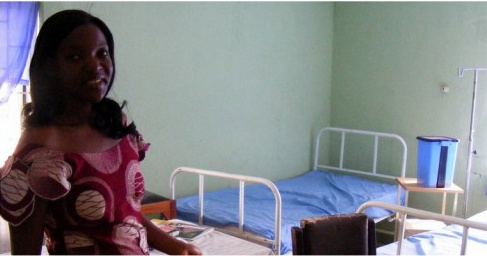
    At a primary healthcare clinic at the Old Legislators Quarters in Jos North local government area, Mrs. Victoria Useni, a senior community health extension worker gave TMV a tour around their facilities. She informed us that, “community health workers are just like community doctors because we handle cases at the primary levels. It is when such cases are beyond our level that we refer to our seniors, who are the doctors.” Useni also lamented that the local residents, many of whom are government officials, often choose to ignore the clinic for primary care and consult with the doctors, who then issue them prescriptions. “Most of the time they don’t patronize the clinic. You will find them going to doctors and when they are given prescription, that’s when they come back to us for injection,” Useni explains.

    Walking around the clinic grounds, only three beds, which used for patient observation, were present. The facility also had a labor room with a few beds and a poorly equipped laboratory. Useni informed us that one of the major challenges facing the clinic, staffed by thirteen people, is the endemic Nigerian problem of power outages. She explains, “Because we don’t have a stand by generator, we often use kerosene lamps, which poses serious problems to us.” Another challenge she cites is the continuous supply of drugs. Recently, a non-governmental organization named GAVI Alliance gave succour for this issue. Mrs. Usaini was also full of praise to the community for their efforts towards providing drugs for the clinic. While the clinic has the capacity to treat minor cases like malaria, they are often referred to bigger hospitals because of its poorly equipped state.

    While visiting other primary health care clinics within the Jos North metropolis, some staff who had just returned from weeks long industrial action were seen cleaning. The secretary of one clinic refused to speak to TMV, but a staff member obliged to comment anonymously, describing the condition of the clinic as pathetic. “You can imagine that it is the staff that buy some of the drugs and subsequently sell to patients,” they informed us. In other words, the clinic has become a money making venture for some of the workers. While moving around the clinic grounds to capture photographs, a security man on duty quickly accosted the TMV crew and ordered us off the premises.

    TMV observed that virtually all the primary care clinics in the Jos North metropolis had problems of continuous drug supply. If primary care clinics within the city metropolis are poorly equipped and supplied with drugs, one can only imagine the conditions of clinics located outside the city, hundreds of kilometers away.

  • Nigerian Schools in Plateau State

    Nigerian Schools in Plateau State

    BY V. AL-PEA

    When Jang became governor of Plateau State in 2007, his government declared a state of emergency on education, stating its goal is to radically improve it. TMV looked at how his government has thus far faired, particularly in primary education.

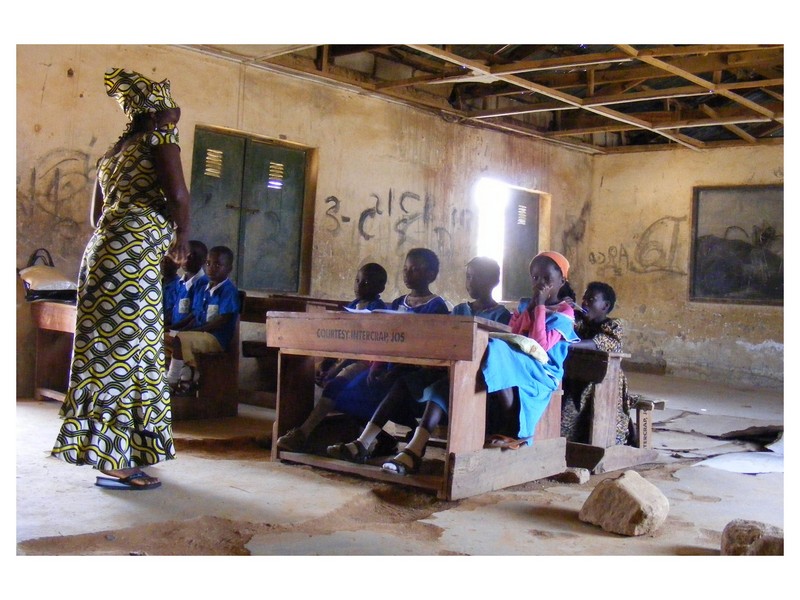
    Our first stop was the Local Education Authority (L.E.A) Primary school in Gwong, Jos north local government area, one of the head teachers, who pleaded anonymity lamented that although the state government has done well in improving the standard of education, structurally there’s still much to be done. A sweeping view of rows of derelict and dilapidated structures appeared completely out of tune with its environment . Not one single of the about nine structures had been renovated in recent times. In their age, some of the buildings had long rusted roofs partly blown off by wind while the ceilings either sagged loosely or were completely torn off. Some walls of the classrooms had collapsed and the floors were broken with numerous pot holes. Sadly, the few pupils had to sit on the floors as they were being tutored due to a lack of chairs.

    At the St. Michael’s RCM primary school in Nassarawa Gwom, still within the city metropolis,
    parents and guardians withdrew their children to private schools because of the very poor structural facilities.

    “We are really suffering,” revealed a female head teacher confiding on condition of anonymity. “Virtually every parent has withdrawn his or her child from this school because of the poor facilities.” She wonders why the Primary Education Board, the relevant body responsible for the maintenance of schools at this level has avoided her school. Attempts to speak with staff of the Primary Education Board proved futile.

    Abubakar Sani, an education consultant commends Plateau State government for trying to radically improve schools after declaring a state of emergency, but he adds that “the problem is in the selective approach towards the implementation.” Sani warns of the danger in not providing safe buildings at the primary school level, “which is the foundation of all academic pursuit”, and cites the concern of “graduating poorly educated children into the larger society [. . .] among world leading technological giants”.

    While proffering solutions, Sani tasked the government and relevant bodies with taking responsibility without bias, adding that building and renovation contractors of educational materials should be supervised.

  • Plateau Nominates New PLASIEC Executives

    Plateau Nominates New PLASIEC Executives

    BY V. AL-PEA

    The Plateau State Government has nominated a Chairman and four members of the Plateau State Independent Electoral Commission (PLASIEC) for role as executives.

    Deputy Governor Ignatius Longian, who has been acting governor while Jonah Jang was away on annual leave, gave the name of Dalyop Peter Pwajok from Jos North local government area as Chairman of the Board. Hajiya Maria Muktar from Wase local government area, Samuel Pam Gyang from Barkin Ladi, Bukar Manji from Pankshin and Fariku Maigari are to serve as members. Other members whose tenure has not expired are Vincent Dawal from Quan Pan, Ismaila Ransa from Bassa and Alfred Dala from Lantang North local government areas.

    The nominees were subsequently ushered into the chambers of the State House of Assembly by the Sergeant at Arms and presented to the lawmakers by Deputy Speaker John Bull Shekarau for screening. All the nominees were subsequently told to take a bow and leave except for Fariku Maigari, who spoke on the value of elections in the state.

    The House then confirmed the nomination of the members, which saw the members thanking the State Government and the legislatures for finding them worth of service to the state. This nomination is coming on the heels of the much-anticipated local government polls.

  • BUSINESS IN JOS

    BUSINESS IN JOS

    BUSINESS IN PLATEAU STATE

    BY V. ALP-PEA

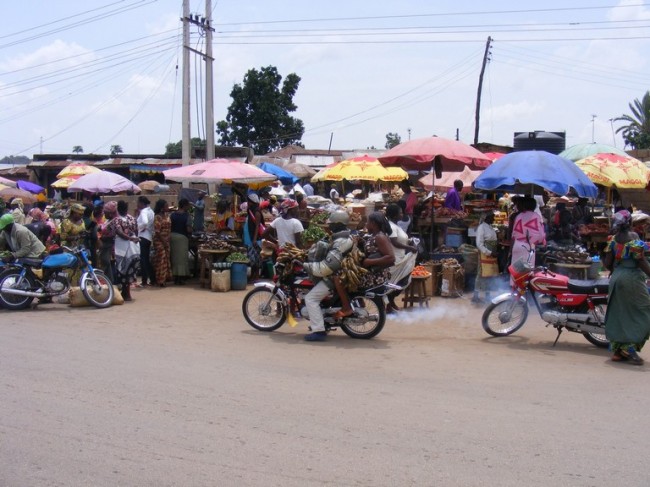
    In the wake of the circle of violence that has rocked the very foundation of Plateau State, virtually all sectors and strata of society have been affected. Worst hit is its socio-economic life. Some businessmen, whose shops were either looted, burnt or both have either relocated to other areas perceived to be safe within the city or in some cases out of the state. And if the crisis has tremendously affected business, the negative press Jos gets has further aggravated issues.

    Irrespective of all these odds, however, most surprising is the business resilience in the city. Business in Jos continues. Is it the cheap varieties of food and vegetables, the benign and marvelous weather or the numerous tourists’ sites scattered across the length and breadth of the Plateau?

    With these questions in mind, TMV took a tour across the business communities in the city on a research of the secret behind the sudden rise in business activities.

    “It is God” Chukwudi Kelechi, a dealer in electronics said. “Everybody knows that Plateau state is strategically placed within this country. That is why even if there’s crisis, just give few hours and normal business activities and life will continue” Kelechi concluded.

    The Vice President of the Traders Union of the Kabong Market, Mr. Peter Anonye while speaking to TMV accepted that despite the security challenges, business continues.

    A visit to the Rukuba Road Satellite Market is a further attestation to the fact that normal business activities have resumed. The market was a beehive of activities as people buy and sell and security personnel are sighted at strategic locations watching all activities with eagle eyes. Staff of the market union manned major entrances frisking persons and vehicles that entered with electronic metal detectors.

    The popular Ahmadu Bello Way was also alive as people were seen transacting business and other markets visited had similar looks. It is the prayer of virtually all residents that the status quo be maintained and sustained.